
This term covers systems and subsystems in which production takes place, for example entire companies as well as individual, value-creating parts of companies such as factories, production segments, workshops or production lines. On the other hand, a production system involves coordinated strategies, principles and methods for production within a specific company. The best-known example is the Toyota production system, which is based on the fundamental idea of avoiding waste and uses methods such as continuous improvement processes, Kanban or just-in-time concepts.
The concept of production economics is based on the idea that production processes can be described as systems, for example as input/throughput/output systems. The input represents goods that are made available to the system from outside for transformation (labor, raw materials, electricity, heat, etc.). The throughput is the actual transformation process, i.e. the change in the processing objects. The output is the release of objects from the production process to the environment, which either leave the company or are further processed. This includes the release of manufactured or modified processing objects, heat or generated electricity, as well as unwanted objects such as exhaust gases, waste water, hazardous waste or chips.
Comparison of different types of production systems
Production systems are differentiated in the literature, particularly according to production types. Different types of planning problems arise depending on whether, for example, individual, series or mass production or workshop or flow production is involved. Solving these problems and thus configuring and controlling production systems as efficiently as possible is the task of production management.
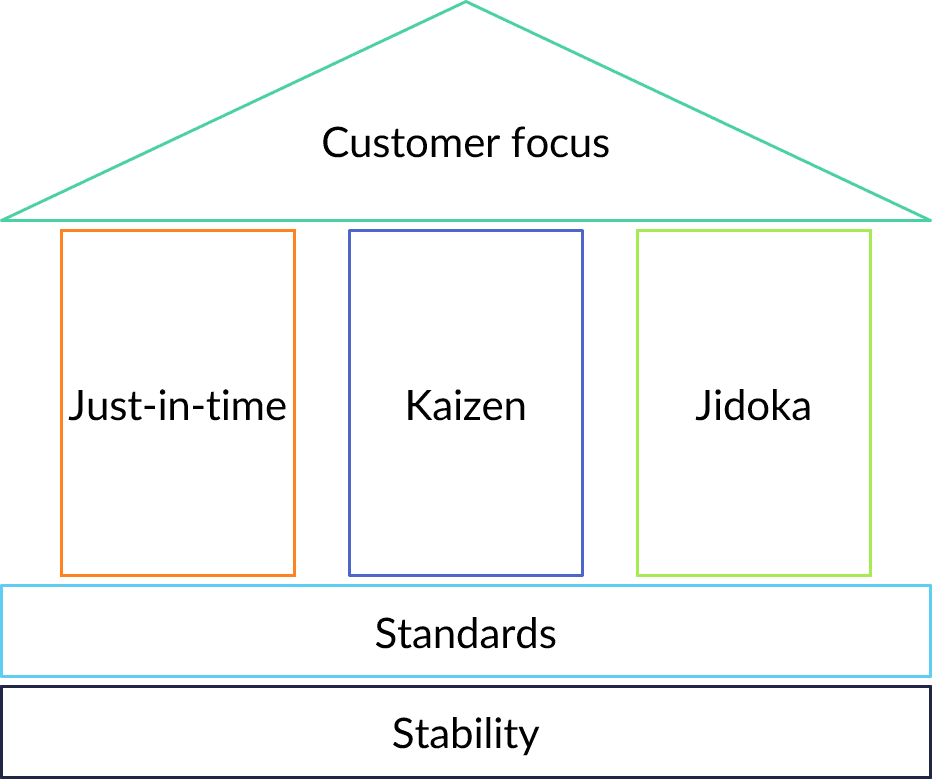
The Toyota Production System
Individual companies have developed their own production systems in which they describe the general principles, standards, methods and tools that apply to the organization and the way of working and producing in their company worldwide. The best known of these production systems is the Toyota Production System (TPS). In the meantime, many companies, especially in the automotive industry, have developed their own production systems, most of which are based on the principles developed by Toyota. Many of the principles, methods and tools first introduced by Toyota also form the basis of lean management.
The comprehensive production system
The second sense of the term has a name of its own: the comprehensive production system (in German Ganzheitliches Produktionssystem, GPS). Fehr, Sauber and Schmidt describe its purpose in 2012 — to combine existing concepts and improvement measures, most of them introduced to fix one specific issue, into a modular system whose methods are aligned with one another. The reason for combining them is a negative one: it prevents isolated approaches from producing local optima that make things worse elsewhere.
That also says what a comprehensive production system is not — a collection of methods. The difference lies in the assignment: every method belongs to a design principle, every principle to a process, every process to a strategic goal.
What it consists of
The structure usually follows four levels: the goals set out in the corporate strategy, the business processes, the design principles and the assigned methods and tools.
One sentence from the same source is routinely underestimated in practice: the structure of comprehensive production systems is the same across companies, while the content differs with the company-specific context. Copying another company's production system means adopting its content, not its effect.
Why the overhead areas belong in it
The original lean production concept aimed predominantly at manufacturing. In a comprehensive production system, Fehr, Sauber and Schmidt note, the overhead areas are increasingly included — design, research and development, planning, sales. The reason is practical: problems arising in manufacturing can often only be solved with those areas involved. The authors point to Taiichi Ōno, founder of the Toyota Production System, who held that its full strength shows only when it is applied as a comprehensive management system. How the sizes of these areas are calculated is covered by indirect areas.
Sources
Fehr, S.; Sauber, K.; Schmidt, T. (2012): Classification of Methods of a Comprehensive Production System, Taking into Account the Requirements of Overhead Areas. Logistics Journal: Proceedings, DOI 10.2195/lj_Proc_fehr_de_201210_01. The structure shown above is Figure 1 there and carries the note "cf. VDI 2870"; it is reproduced here as a secondary citation because the guideline itself is not available to us.
Production system in practice: Our services overview brings together the relevant planning and consulting approaches.