
Sales and Operations Planning (S&OP) is an integrative planning process that aligns demand, production, inventory and financial planning in a fixed cycle. The process connects strategic corporate planning with operational execution and produces agreed volume and capacity decisions on one shared set of data.
In many companies a gap opens up between strategic planning and day-to-day operations: demand expectations, the production programme and inventory are updated in separate cycles and on different sets of data. Deviations only become visible once they show up as shortages or excess stock. Sales and Operations Planning closes that gap through a fixed, cross-functional alignment cycle.
S&OP as an integrative process
Sales and Operations Planning is a process that aligns the various functions of a company while simultaneously balancing supply and demand. S&OP gives managers a comprehensive overview of their business so they can understand how and where their company stands. This allows them to continually align long-term strategy with day-to-day operational tactics across all departments. Simply put, a company can get into trouble if it sells far more than it produces, or if it produces far more than it sells. The goal of the S&OP process is to keep everything in balance. S&OP makes the interdependencies between demand, capacity and inventory ready for decision, and defines which function owns which deviation.
Production and sales in harmony
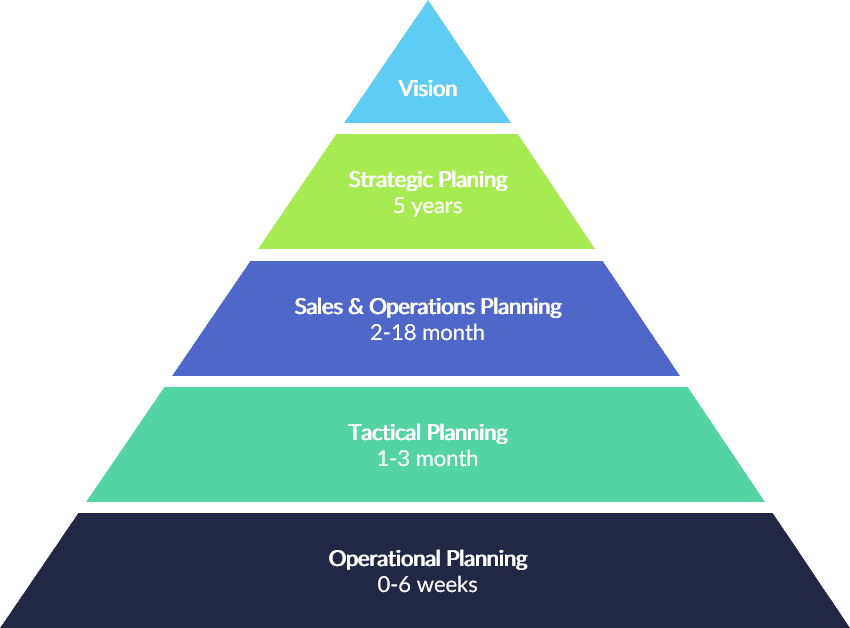
The purpose of the S&OP process is to bring the finance, sales and production perspectives into a decision-making process. These different stakeholders should balance demand and supply as well as integrate financial planning. A look at the planning pyramid illustrates the time horizon of the S&OP process. The planning pyramid shows that the S&OP process provides the guidelines and rules for the tactical and operational process. The S&OP process must therefore be linked to the strategic, operational and tactical processes. The level of detail should correspond to the time horizon. For many companies, the long time horizon is too detailed. Digging deep over the long term does not increase the value of the decision-making process, it only prolongs it. Long-term planning must be done at an aggregated level.
This is because detailed long-term planning does not improve accuracy and requires a great deal of effort. S&OP is about making decisions on a long-term and aggregated level. Meaning the overarching strategy in the annual business plan is aligned with the sales plan, the production plan, the marketing plan, the new product development plan, the inventory/backlog plan, the financial plan and much more. The S&OP process alerts managers to timely adjustment needs they should make in each area.
Sales and Operations Planning in practice: Our services overview brings together the relevant planning and consulting approaches.